When pain, injury, surgery, or prolonged inactivity changes the way you move, your body may begin relying on compensation patterns.
You may place more weight on one side.
You may avoid using an injured arm or leg.
You may feel less steady while walking.
Or movements that once felt automatic may begin to require more concentration.
At Cucci Chiropractic, we evaluate how your muscles, joints, balance systems, and movement patterns work together.
For some patients, we may incorporate neuromuscular re-education, also commonly called neuro re-education, into an individualized care plan.
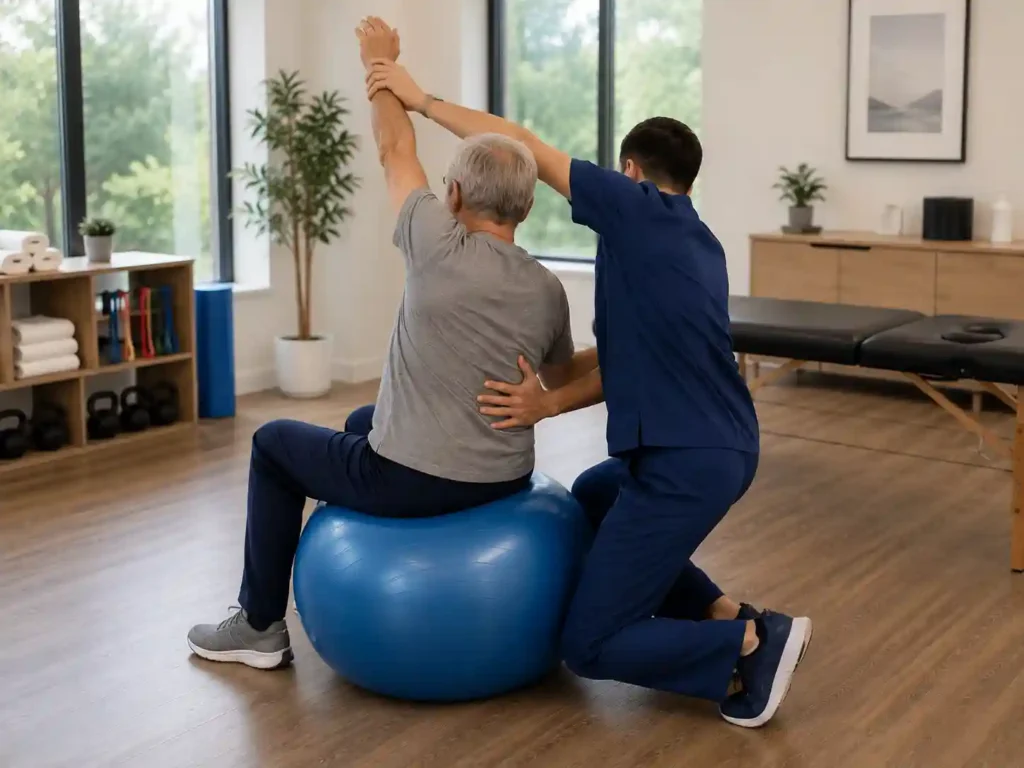
Neuromuscular re-education uses guided movement, balance activities, coordination exercises, and other appropriate techniques to help you practice safer and more efficient movement patterns.
The goal is not to “reset” or “retrain” the nervous system in one session.
Instead, we use carefully selected exercises and hands-on guidance to help you improve body awareness, coordination, balance, posture, and movement control over time.
We do not assume that every movement problem requires the same program.
Before recommending neuromuscular re-education, we will discuss your symptoms, evaluate how you move, and determine whether this approach may be appropriate for your individual needs.
Book a consultation and we’ll assess whether Neuro Re-Education is right for you.
Neuromuscular re-education is a therapeutic approach focused on improving the way your nervous system and muscles coordinate movement.
Your brain, nerves, muscles, joints, vision, and balance systems continually exchange information while you move.
This communication helps you:
- Maintain posture
- Control your balance
- Coordinate your arms and legs
- Adjust to changes in surface or position
- Respond to unexpected movement
- Perform everyday tasks efficiently
After an injury, surgery, period of inactivity, or significant pain episode, movement may change.
You may begin protecting one side of your body.
Some muscles may work harder than necessary, while others may become less active.
You may also lose confidence in movements that once felt easy.
Neuromuscular re-education gives you an opportunity to practice movement with guidance, feedback, and appropriate progression.
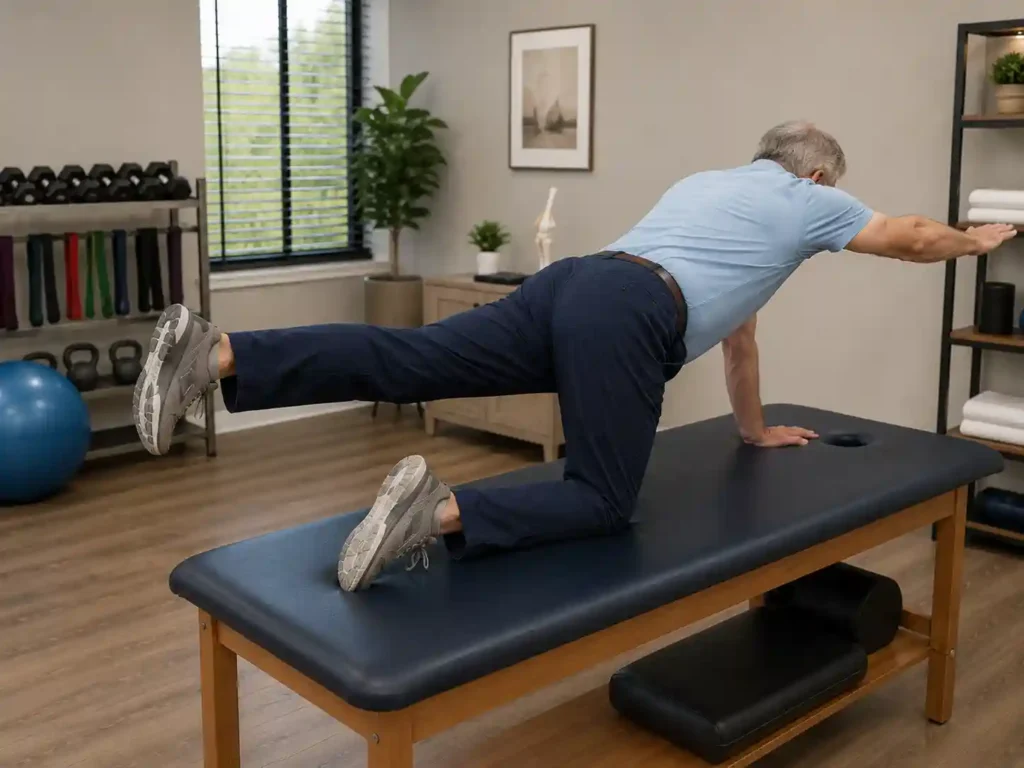
Depending on your needs, we may focus on balance, posture, coordination, muscle activation, gait, or functional movement.
Why Do Movement Patterns Change?
Movement patterns can change for many reasons.
Sometimes the change begins immediately after an injury.
In other situations, it develops gradually as the body adapts to pain, stiffness, or weakness.
Pain and Protective Movement
When an area hurts, the body often tries to protect it.
You may shorten your stride because of knee pain.
You may avoid turning your neck fully.
You may lift with one arm more than the other.
These changes can be useful temporarily, but they may continue even after the original symptoms begin to improve.
Over time, surrounding muscles and joints may take on additional work.
Neuromuscular re-education may help you gradually become more aware of these compensations and practice more comfortable movement patterns.
Injury
Sprains, strains, falls, sports injuries, and motor vehicle accidents may affect strength, coordination, confidence, and joint awareness.
Even after injured tissues begin recovering, you may not automatically return to your previous movement pattern.
Your body may continue protecting the area.
We evaluate how you are currently moving and determine whether guided exercises or movement retraining may support your recovery.
Surgery
After surgery, movement may be limited for a period of time.
You may also experience weakness, stiffness, or uncertainty when using the affected area again.
Neuromuscular re-education may be considered as part of a coordinated recovery plan when it is appropriate and consistent with your surgeon’s recommendations.
We will review any post-surgical restrictions before beginning treatment.
If additional clearance is necessary, we will discuss that with you.
Prolonged Inactivity
Illness, injury, sedentary work, and extended periods of limited activity may affect balance, strength, and movement confidence.
When you begin becoming active again, movements may feel less coordinated than they once did.
Starting gradually and practicing appropriate exercises can be an important part of returning to activity.
Repetitive Habits
The body becomes efficient at movements it repeats frequently.
Unfortunately, this also applies to less helpful movement patterns.
Sitting in the same posture, favoring one leg, repeatedly reaching with one arm, or compensating during exercise may gradually become habitual.
We look at these patterns during your evaluation and determine whether neuromuscular re-education may help you practice a different strategy.
Who May Benefit From Neuromuscular Re-Education?
Neuromuscular re-education may be considered for patients experiencing certain balance, coordination, posture, or movement concerns.
At Cucci Chiropractic, we may evaluate patients with:
- Reduced balance
- Gait changes
- Decreased coordination
- Postural control concerns
- Weakness following injury
- Movement compensation after pain
- Reduced body awareness
- Sports-related movement problems
- Difficulty returning to activity
- Post-surgical movement limitations
- Recurrent ankle instability
- Difficulty activating selected muscles
- Fear or hesitation during movement
- Reduced confidence with everyday activities
A symptom list alone does not determine whether this treatment is right for you.
We first need to understand why the movement problem is occurring.
Some symptoms may require evaluation by a neurologist, physical therapist, orthopedic specialist, or another healthcare provider.
If your findings suggest care outside our scope, we will explain our concerns and recommend an appropriate next step.
Neuromuscular Re-Education for Balance
Balance depends on several systems working together.
Your body uses information from your eyes, inner ears, joints, muscles, and nervous system to understand where you are in space.
When one or more of these systems are not functioning efficiently, you may feel unsteady or less confident.
During your evaluation, we may look at:
- Standing balance
- Weight shifting
- Single-leg control
- Postural stability
- Walking
- Transitions between positions
- Lower body strength
- Joint mobility
- Reaction to controlled challenges
Balance training should be appropriate for your current ability.
We do not begin with difficult exercises simply to make a program look advanced.
We start with a level you can perform safely and progress based on your response.
Gait and Walking-Related Concerns
Walking is a complex activity.
Your feet, ankles, knees, hips, pelvis, spine, arms, vision, and balance systems all contribute.
Pain or weakness in one area may change the way you walk.
You may take shorter steps.
You may spend less time on one leg.
You may shift your body to avoid discomfort.
During your assessment, we may observe:
- Step length
- Weight distribution
- Arm movement
- Foot placement
- Balance
- Hip and knee movement
- Trunk position
- Walking speed
If we identify a movement pattern that may be appropriate for retraining, we can use guided practice and feedback as part of your care.
However, gait changes can also be associated with neurological or medical conditions.
When additional evaluation is appropriate, we will recommend it.
Postural Control and Body Awareness
Posture is not one perfect position that must be maintained all day.
Healthy posture involves the ability to change positions and control your body during different activities.
Problems may develop when you remain in one position for too long or have difficulty controlling alignment during movement.
For example, you may notice:
- Your shoulders rounding during computer work
- Your head moving forward as you become tired
- Your knees moving inward during a squat
- Your body shifting to one side while standing
- Difficulty maintaining balance during reaching
Neuromuscular re-education may include exercises that help you become more aware of these patterns and practice improved control.
The goal is not to make you rigid.
The goal is to help you move with greater awareness and adaptability.
Movement Training After a Sports Injury
Returning to sport involves more than waiting for pain to decrease.
You also need enough strength, balance, coordination, and confidence to tolerate the demands of your activity.
An athlete recovering from an ankle injury may need to practice balance and landing control.
Someone returning to lifting may need to rebuild movement quality under gradually increasing resistance.
A runner may need to address lower body control or confidence following an injury.
During your evaluation, we will discuss:
- Your sport
- Your position or activity
- The original injury
- Movements associated with symptoms
- Training volume
- Previous injuries
- Your goals for returning
When appropriate, neuromuscular re-education may become one part of your return-to-activity plan.
We do not promise that one exercise or technique will prevent future injuries.
Our goal is to help you improve the physical qualities needed for your activity and progress at an appropriate pace.
Recurrent Ankle Instability
After an ankle sprain, some people continue to feel as though the ankle is unstable or may give way.
The injury may affect balance, joint awareness, muscle activation, and confidence.
Neuromuscular re-education may include:
- Controlled weight shifting
- Balance exercises
- Ankle and foot awareness
- Lower body coordination
- Gradual single-leg activities
- Functional movement practice
The exercises used depend on your current ability and the stage of recovery.
If significant swelling, pain, weakness, or repeated instability is present, additional evaluation may be appropriate.
Neuromuscular Re-Education After Surgery
Following an orthopedic procedure, you may need to relearn how to move confidently and efficiently.
Depending on the surgery, your body may have adapted to pain or reduced movement before the procedure.
Those habits may remain during recovery.
When appropriate and medically cleared, neuromuscular re-education may help you practice:
- Weight shifting
- Standing control
- Walking
- Joint positioning
- Muscle activation
- Functional movement
- Everyday tasks
We do not provide post-surgical treatment without considering your restrictions and medical recommendations.
If coordination with your surgeon or rehabilitation provider is needed, we will discuss that before beginning care.
Neuromuscular Re-Education and Chronic Pain
Chronic pain is complex.
It may involve physical, neurological, emotional, environmental, and lifestyle factors.
We do not tell patients that movement retraining will correct every source of chronic pain.
However, persistent pain can change how you move.
You may become fearful of certain motions.
You may brace excessively.
You may avoid using an area even when gentle movement is appropriate.
For selected patients, neuromuscular re-education may focus on rebuilding confidence with controlled movement.
We begin with activities appropriate for your current tolerance and progress gradually.
Our goal is not to force you through pain.
It is to help you explore movement in a controlled and supported way.
Neurological Conditions and Appropriate Coordination of Care
The original version of this page stated that neuromuscular re-education treats conditions such as Parkinson’s disease and multiple sclerosis.
That wording is too broad for a chiropractic service page.
Parkinson’s disease, multiple sclerosis, stroke, and other neurological conditions require appropriate medical diagnosis and management.
Some people with neurological conditions may participate in movement, balance, or rehabilitation programs under the direction of qualified healthcare providers.
However, we do not claim that neuromuscular re-education at Cucci Chiropractic treats or reverses a neurological disease.
If you have a diagnosed neurological condition, we will review your history and determine whether coordinated care, medical clearance, or referral is appropriate.
Your safety and continuity of care come first.
Techniques We May Use
Neuromuscular re-education is not one single exercise or treatment.
Depending on your individual needs, care may include several approaches.
Guided Movement Practice
We may guide you through controlled movements and provide verbal, visual, or hands-on feedback.
This helps you understand how you are moving and make adjustments during the activity.
Balance Training
Balance activities may begin with a stable surface and a wide base of support.
As your control improves, exercises may become more challenging.
Progression should be gradual and appropriate.
Coordination Exercises
Coordination training may involve controlled upper and lower body movements, reaching, stepping, or task-specific practice.
The goal depends on your individual movement concern.
Functional Movement Training
Functional training focuses on activities that relate to your daily life, work, or recreation.
Examples may include:
- Sitting and standing
- Stepping
- Squatting
- Reaching
- Carrying
- Walking
- Changing direction
- Moving from one surface to another
We select exercises based on what you need to do—not simply what looks difficult.
Manual Guidance
Hands-on guidance may help you understand the direction or quality of a movement.
We may also use appropriate manual therapy or chiropractic care when joint or soft tissue findings appear to be contributing to your movement problem.
Neuromuscular Electrical Stimulation
Neuromuscular electrical stimulation, commonly called NMES, uses controlled electrical stimulation to produce muscle contractions.
It may be considered in selected rehabilitation settings.
However, we only include this service on the page if Cucci Chiropractic actually provides it.
If NMES is used, we will explain why it is being recommended and how it fits into your treatment plan.
Feedback and Body Awareness
Feedback may include mirrors, touch cues, verbal guidance, or simple performance measures.
The purpose is to help you better recognize how your body is moving.
We do not need complicated technology for every patient.
The type of feedback should match your needs and goals.
What to Expect During Your First Visit
Your first visit begins with a conversation.
We want to understand:
- What movement feels difficult
- When the problem began
- Previous injuries
- Surgeries
- Falls
- Your medical history
- Activities associated with symptoms
- Your work and exercise
- Your goals for care
- Other healthcare providers involved in your treatment
Next, we may evaluate:
- Balance
- Gait
- Posture
- Coordination
- Range of motion
- Joint mobility
- Strength
- Functional movement
- Neurological findings when appropriate
We will explain what we observe and discuss whether neuromuscular re-education may be appropriate.
If another healthcare provider should evaluate your symptoms first, we will tell you.
How Do We Measure Progress?
Progress looks different for every patient.
We may monitor changes in:
- Balance time
- Walking confidence
- Movement quality
- Range of motion
- Control during selected exercises
- Ability to perform daily tasks
- Tolerance for activity
- Confidence with movement
- Frequency of compensation
- Achievement of personal goals
We do not judge progress based only on pain.
For some patients, meaningful improvement may include walking more confidently, using stairs more comfortably, or returning to a valued activity.
Your goals help define what progress means.
How Many Sessions Will I Need?
There is no universal number of sessions.
Your care may depend on:
- The cause of the movement problem
- How long it has been present
- Previous injuries
- Your general health
- The complexity of the task
- Your activity level
- Your goals
- Your consistency
- Your response to treatment
We will reassess your movement and adjust the program based on your progress.
If the treatment is not producing meaningful change, we will reconsider the plan rather than repeating the same exercises indefinitely.
Is Neuromuscular Re-Education Right for Everyone?
No.
Movement difficulties may have many causes.
Some require medical testing, neurological evaluation, imaging, or care from another rehabilitation specialist.
We will review your symptoms and health history before recommending treatment.
Signs such as sudden weakness, facial drooping, loss of coordination, severe dizziness, new difficulty speaking, or sudden changes in walking require urgent medical attention rather than a routine chiropractic appointment.
If we believe your symptoms fall outside the appropriate scope of our care, we will recommend the next step.
Can Neuromuscular Re-Education Be Combined With Chiropractic Care?
Yes, when appropriate.
Movement problems may sometimes be influenced by joint restriction, muscle tension, pain, or reduced confidence.
Depending on your examination findings, your plan may include:
- Chiropractic care
- Manual therapy
- Balance training
- Functional movement exercises
- Kinesiology taping
- Soft tissue techniques
- Mobility recommendations
- Neuromuscular re-education
We do not automatically combine every service.
Each part of your plan should have a clear purpose.
If we recommend multiple approaches, we will explain how they work together.
We Build Movement Gradually
More difficult exercises are not automatically better.
At Cucci Chiropractic, we begin with what you can currently perform safely.
We then progress based on control, confidence, symptoms, and your individual goals.
We do not want you struggling through exercises simply to complete them.
Quality matters.
Consistency matters.
Appropriate progression matters.
The goal is to help you build movement skills that support everyday life—not to make every session unnecessarily complicated.
Why Choose Cucci Chiropractic for Neuromuscular Re-Education?
At Cucci Chiropractic, we believe movement care should be based on the person in front of us.
We do not use the same balance or coordination program for every patient.
Our approach focuses on:
- Individualized evaluations
- Personalized movement plans
- Clear explanations
- Gradual progression
- One-on-one guidance
- Conservative care
- Honest recommendations
- Ongoing progress assessment
We do not promise to “retrain” your entire nervous system or correct every movement problem.
We evaluate you first.
If neuromuscular re-education may support your goals, we will explain why and how we plan to use it.
If another form of care is more appropriate, we will discuss that honestly.
Schedule Your Neuromuscular Re-Education Consultation Today!
If an injury, surgery, balance problem, or movement limitation has made you feel less confident in your body, we are here to help you better understand what may be contributing.
At Cucci Chiropractic, we will begin with an individualized evaluation.
We will listen to your concerns.
We will assess your balance, coordination, movement, and physical findings.
We will consider your medical history and personal goals.
Then we will determine whether neuromuscular re-education or another treatment approach may be appropriate for your needs.