
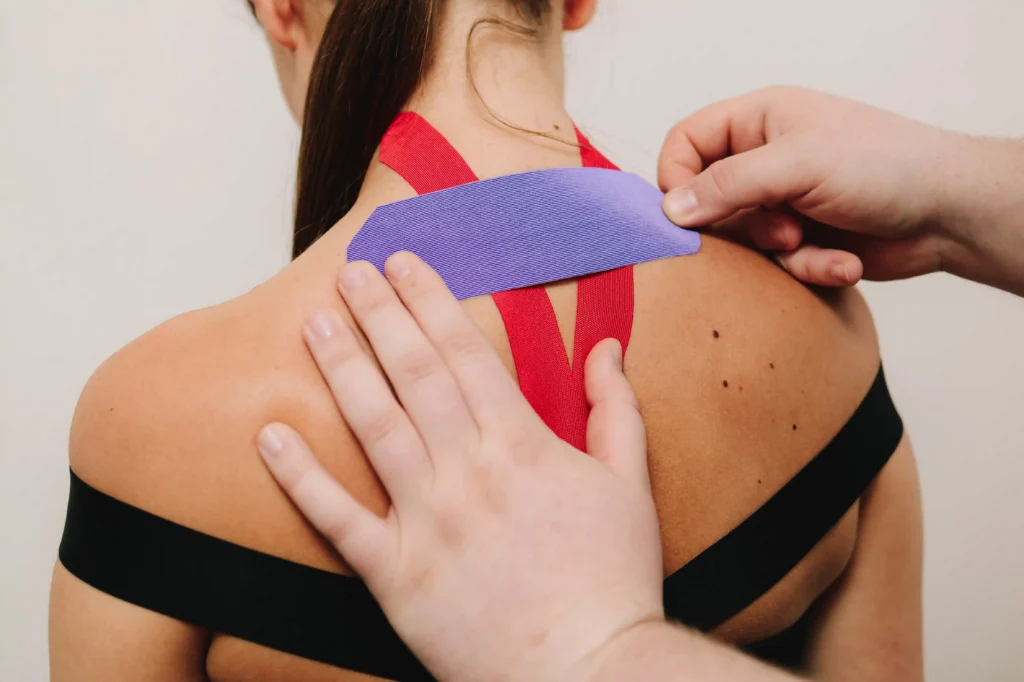
Muscle tension, joint discomfort, and sports-related injuries can make everyday movement feel more difficult. Kinesiology taping is a flexible, supportive technique that may help provide sensory feedback, support selected muscles and joints, and encourage greater awareness of movement without significantly restricting your normal range of motion.
At Cucci Chiropractic, I use kinesiology taping as part of an individualized care plan when an evaluation indicates that it may be appropriate. The tape may be applied to areas such as the shoulder, knee, lower back, neck, or lower leg to complement chiropractic care, manual therapy, therapeutic exercises, or activity modifications.
Kinesiology tape is not a cure or a replacement for proper evaluation and rehabilitation. Its purpose depends on your symptoms, movement patterns, activity level, skin sensitivity, and treatment goals. Before applying the tape, I will assess the affected area and explain how the application may support your broader care plan.
Whether you are managing a sports-related concern, muscle tension, repetitive strain, or discomfort during movement, my goal is to provide personalized care that supports comfortable and confident activity.
Book a consultation and we’ll assess whether Kinesiology Taping is right for you.
Kinesiology taping is a supportive treatment technique that uses flexible, elastic tape applied directly to the skin.
The modern kinesiology taping method was developed in the 1970s by Dr. Kenzo Kase. The technique was designed to provide support while allowing greater freedom of movement than traditional rigid athletic taping.
Depending on the product being used, kinesiology tape is typically made with an elastic fabric and an adhesive designed for extended contact with the skin.
The tape may remain in place during normal daily activities for a period of time when your skin tolerates it appropriately.
What makes kinesiology tape different is the way it’s applied.
We consider:
- The area being supported
- The direction of the tape
- Your movement pattern
- The amount of stretch used
- Your skin sensitivity
- Your activity level
- The goal of the application
There isn’t one taping pattern that works for every patient.
That’s why proper evaluation and individualized application matter.
How Does Kinesiology Tape Work?
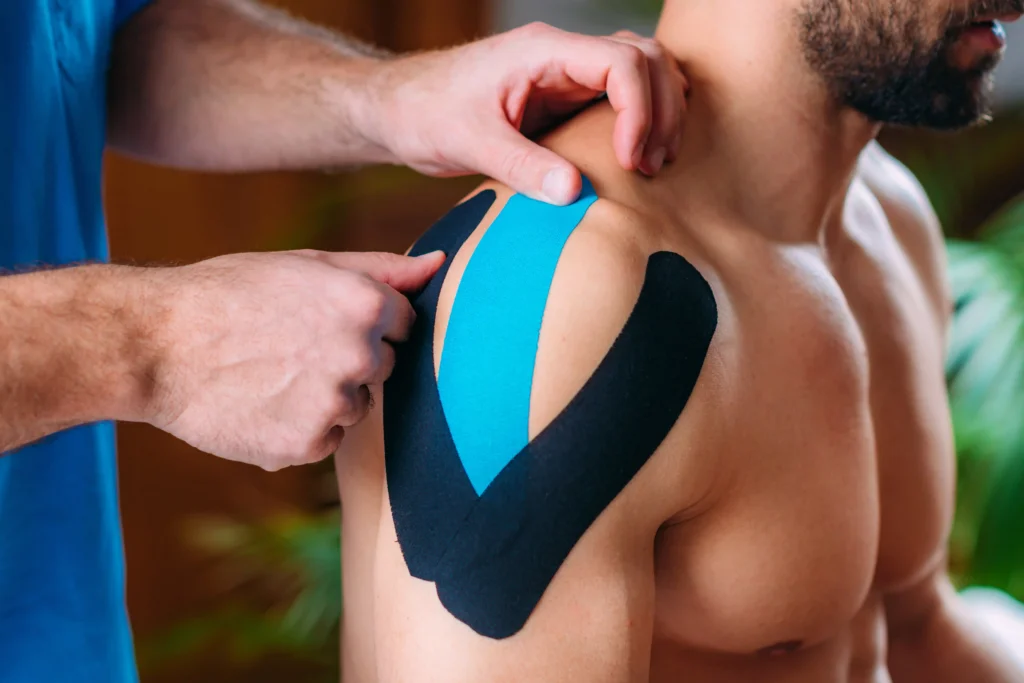
Kinesiology taping is often discussed online as though the tape itself can “heal” an injury.
We take a more realistic approach.
The tape doesn’t replace the body’s normal healing process, and it doesn’t correct every muscle or joint problem.
Instead, kinesiology tape may provide additional sensory input through the skin while you move.
Your skin, muscles, joints, and nervous system continually exchange information about movement and body position.
This awareness of your body’s position and movement is commonly referred to as proprioception.
For some patients, the sensation of tape on the skin may provide feedback that helps them become more aware of a particular area during movement.
Depending on how the tape is applied, we may use it as a supportive tool alongside hands-on treatment, movement recommendations, or therapeutic exercises.
Our goal is not to make exaggerated claims about what a strip of tape can accomplish.
Our goal is to determine whether kinesiology taping may be useful as one part of your individualized care plan.
Kinesiology Tape vs. Traditional Athletic Tape
Kinesiology tape and traditional athletic tape aren’t the same.
Traditional athletic taping is often used to limit or control movement around a joint. Athletes may use rigid tape when additional external support or movement restriction is desired.
Kinesiology tape is more flexible.
It’s generally applied in a way that allows you to continue moving through your normal or modified range of motion.
This can make kinesiology taping useful when we want to provide support or sensory feedback without significantly restricting everyday movement.
The right type of taping depends on your condition and goals.
In some situations, movement restriction may be appropriate.
In others, maintaining comfortable movement is an important part of recovery.
We’ll evaluate your needs before recommending a taping approach.
Why Do We Use Kinesiology Taping?
We may consider kinesiology taping for several different reasons.
For one patient, the goal may be to provide additional feedback around a shoulder during movement.
For another, taping may be used to complement a rehabilitation exercise program.
An athlete may benefit from support during selected activities, while someone recovering from a musculoskeletal injury may use tape as part of a gradual return to normal movement.
Depending on your examination findings, we may consider kinesiology taping to:
- Provide sensory feedback during movement
- Support selected muscles or joints
- Complement therapeutic exercises
- Encourage awareness of movement patterns
- Provide flexible support during certain activities
- Support a gradual return to activity
- Complement chiropractic or manual therapy
The purpose of taping should always be clear.
We don’t believe in applying tape without understanding what we’re trying to accomplish.
Conditions and Symptoms We Commonly Evaluate
Kinesiology taping may be considered for a variety of musculoskeletal concerns.
At Cucci Chiropractic, we may evaluate patients experiencing:
- Muscle strains
- Mild sprain-related symptoms
- Shoulder discomfort
- Knee discomfort
- Lower back muscle tension
- Neck and upper back tension
- Shin discomfort related to activity
- Tendon-related symptoms
- Repetitive strain
- Sports-related injuries
- Postural movement concerns
- Muscle fatigue
- Restricted or uncomfortable movement
This doesn’t mean kinesiology tape is automatically appropriate for every person with these symptoms.
The same symptom can have many different causes.
That’s why we evaluate you before making treatment recommendations.
Kinesiology Taping for Sports and Active Lifestyles
Athletes place significant demands on their bodies.
Running, lifting, cycling, tennis, golf, and recreational sports all require muscles and joints to coordinate movement efficiently.
When an injury occurs or a particular area becomes uncomfortable, athletes often begin compensating.
You may shorten your stride.
You may change your lifting technique.
You may avoid using one shoulder.
These changes may allow you to continue your activity temporarily, but they can also alter normal movement patterns.
During your evaluation, we’ll assess the affected area and look at how you move.
When appropriate, we may use kinesiology taping as a supportive tool while you participate in selected activities or complete recommended exercises.
The tape isn’t a substitute for rehabilitation.
It may be one part of a broader plan focused on helping you return to activity safely and confidently.
Kinesiology Taping for Shoulder Support
The shoulder depends on coordinated movement between multiple joints and muscle groups.
When shoulder movement becomes uncomfortable, it’s important to evaluate more than the shoulder itself.
We may also assess your:
- Neck
- Upper back
- Shoulder blade movement
- Posture
- Muscle function
- Range of motion
If we determine that kinesiology taping may be useful, we’ll apply the tape based on your individual movement pattern and treatment goals.
For some patients, the sensation of the tape provides helpful feedback during reaching, lifting, or therapeutic exercise.
We may combine taping with other appropriate treatments when necessary.
Kinesiology Taping for Knee Discomfort
Knee symptoms can affect walking, climbing stairs, exercising, and everyday activities.
However, knee discomfort isn’t always caused by one structure.
Movement involving the hips, ankles, and surrounding muscles may influence how forces are distributed through the knee.
That’s why we don’t simply place tape over the painful area.
We’ll evaluate how your lower body moves and identify factors that may be contributing to your symptoms.
When appropriate, kinesiology taping may be used to provide flexible support or movement feedback as part of your overall care plan.
Kinesiology Taping for Lower Back Muscle Tension
Lower back discomfort can have many contributing factors.
Prolonged sitting, repetitive lifting, changes in activity, muscle fatigue, and restricted movement may all influence how the lower back feels.
For selected patients, we may use kinesiology tape as a temporary supportive technique.
The tape may provide sensory feedback during movement and remind you of certain positions or movement patterns throughout the day.
However, we don’t rely on taping alone.
If your examination identifies joint restrictions, muscle imbalances, or movement habits that may be contributing to your symptoms, we’ll discuss those findings and recommend appropriate care.
Kinesiology Taping for Shin and Lower Leg Discomfort
Runners and active adults sometimes experience discomfort through the shin or lower leg.
Sudden increases in training, changes in footwear, running surfaces, and movement mechanics may all contribute to lower leg symptoms.
Before recommending taping, we’ll evaluate your symptoms and activity history.
We may also look at ankle mobility, lower leg muscle function, and other movement factors.
If kinesiology taping is appropriate, it may be incorporated as a supportive tool alongside activity modifications, mobility work, or other treatment recommendations.
How Kinesiology Taping Fits Into Chiropractic Care?
At Cucci Chiropractic, kinesiology taping isn’t a stand-alone answer to every injury.
We use it when we believe it can support a broader treatment goal.
Depending on your individual needs, your care plan may include:
- Chiropractic care
- Manual therapy
- Trigger point release techniques
- Soft tissue techniques
- Shockwave Therapy
- Therapeutic movement
- Mobility recommendations
- Kinesiology taping
We don’t automatically combine every treatment.
Each technique should have a specific purpose based on your examination findings.
For example, we may use hands-on care to address an area of restricted movement and then apply kinesiology tape to provide additional sensory feedback as you return to your daily activities.
For another patient, taping may not be necessary at all.
Our treatment decisions are based on the person—not a predetermined protocol.
What to Expect During Your First Kinesiology Taping Appointment?
Your first visit begins with a conversation.
We’ll discuss your symptoms, when they began, and how they affect your daily activities.
We may ask about:
- Previous injuries
- Sports or exercise
- Work activities
- Repetitive movements
- Treatments you’ve already tried
- Your health history
- Your goals for care
Next, we’ll perform an examination based on your symptoms.
Depending on the area involved, we may evaluate joint mobility, muscle function, flexibility, posture, and movement patterns.
If we determine that kinesiology taping is appropriate, we’ll explain why we recommend it and what we’re trying to accomplish.
We’ll then prepare the skin and apply the tape using a pattern selected for your individual needs.
The application itself is generally quick.
We’ll ask you to move after the tape is applied so we can evaluate your comfort and make sure the application doesn’t unnecessarily restrict movement.
What Does Kinesiology Tape Feel Like?
Most patients describe kinesiology tape as light and flexible.
You may notice a gentle pulling or lifting sensation on the skin, particularly when you move.
The tape shouldn’t feel painfully tight.
It also shouldn’t cause significant numbness, tingling, or increasing discomfort.
We’ll explain what to monitor while you’re wearing the tape.
If you develop significant skin irritation or another concerning reaction, you should remove the tape and contact us with any questions.
Your comfort and skin response are important parts of deciding whether kinesiology taping is appropriate for continued use.
How Long Can I Wear Kinesiology Tape?
How long you wear kinesiology tape depends on the application, your activity level, and how your skin responds.
We’ll provide specific instructions based on the tape used and your individual treatment plan.
You may be able to continue many normal daily activities while wearing the tape.
However, the tape shouldn’t replace activity modifications when rest or reduced physical demand is appropriate for your condition.
We’ll explain what activities you can continue and whether temporary modifications are recommended.
We Use Taping With a Purpose
Kinesiology tape is easy to purchase.
Knowing why, where, and how to apply it is more important.
At Cucci Chiropractic, we don’t view kinesiology taping as a cure or a stand-alone solution.
We use it as a supportive technique when our evaluation suggests it may complement your care.
We look at your movement.
We evaluate your muscles and joints.
We discuss your daily activities.
We consider your goals.
Then we determine whether taping makes sense for you.
If it does, we’ll explain the purpose of the application and how it fits into your treatment plan.
If it doesn’t, we’ll recommend another approach.
Why Choose Cucci Chiropractic for Kinesiology Taping?
At Cucci Chiropractic, we believe even a simple treatment technique should be personalized.
We don’t apply the same taping pattern to every shoulder, knee, or lower back.
Our approach focuses on:
- Individualized evaluations
- Personalized treatment recommendations
- Care based on your movement and symptoms
- Clear explanations
- Conservative treatment options
- One-on-one attention
- Ongoing progress assessment
Our goal isn’t simply to put tape over the area that hurts.
We want to understand what’s contributing to your symptoms and determine how kinesiology taping may fit into your overall care.
Schedule Your Kinesiology Taping Consultation
If pain, muscle tension, or an injury is affecting the way you move, we’ll help you better understand what’s happening.
At Cucci Chiropractic, we’ll begin with a personalized evaluation and discuss your symptoms, activities, and treatment goals.
If kinesiology taping is appropriate, we’ll apply the tape based on your individual needs and explain how it fits into your care plan.
If another treatment approach is more appropriate, we’ll discuss that honestly.