When one side of your body feels different from the other, you may begin wondering whether your legs are the same length.
You may notice that one pant leg seems to sit differently.
One shoe may wear faster.
You may feel as though you place more weight on one side while standing.
Or you may have recurring lower back, hip, knee, or foot discomfort that seems to change depending on how long you walk or stand.
At Cucci Chiropractic, we do not assume that every postural or lower body problem is caused by a leg length difference.
We evaluate you first.
For selected patients, we may consider a heel lift or foot lift when our examination identifies a measurable difference or movement pattern that may benefit from additional support.
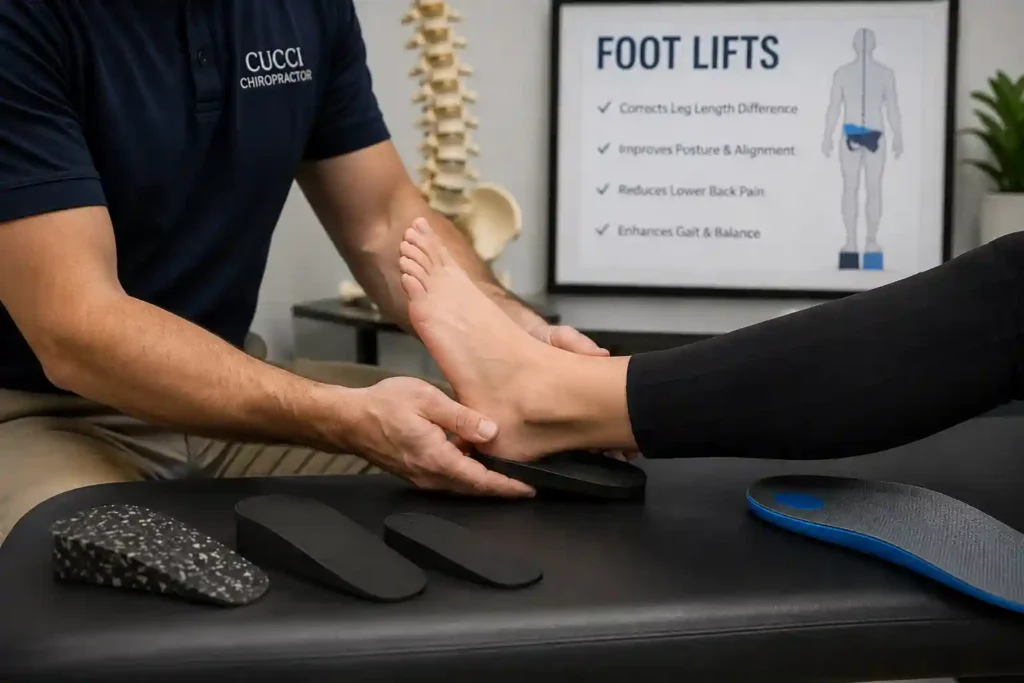
A foot lift is a shoe insert designed to add height or support beneath part or all of the foot.
The amount of lift matters.
More height is not automatically better.
Our goal is to understand how you stand, walk, and move before recommending a lift.
If we believe a heel or foot lift may be appropriate, we will explain what we found, why we are recommending it, and how we want you to begin using it.
Book a consultation and we’ll assess whether Foot Lifts is right for you.
A foot lift is an insert placed inside or incorporated into footwear to add a selected amount of height beneath the foot.
Depending on your individual needs, a lift may be placed primarily beneath the heel or extend beneath a larger portion of the foot.
Foot lifts are sometimes considered when evaluating:
- Leg length differences
- Uneven weight distribution
- Selected gait changes
- Pelvic compensation
- Lower body movement concerns
- Certain post-surgical situations
- Footwear-related support needs
The purpose of a foot lift depends on why we are recommending it.
For one patient, we may be addressing a measurable leg length difference.
For another, we may be evaluating a temporary support need during recovery.
That is why we do not recommend lifts based only on symptoms or appearance.
We first want to understand what is happening.
What Is a Leg Length Difference?
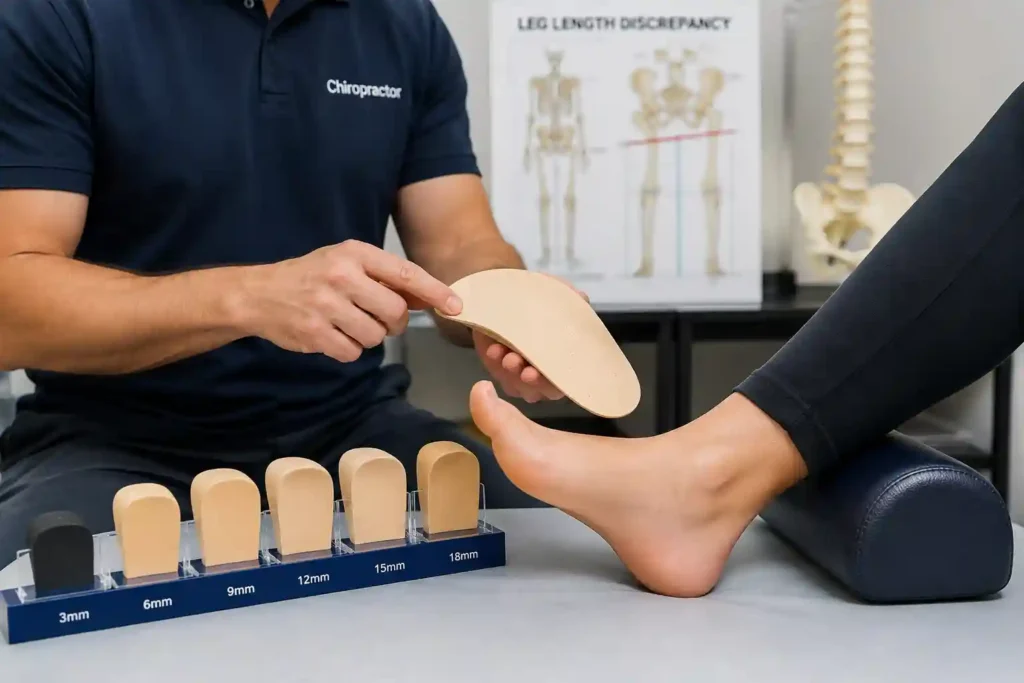
A leg length difference, also called a leg length discrepancy, means one leg measures or functions differently in length compared with the other.
However, there is an important distinction between a structural leg length difference and a functional leg length difference.
Structural Leg Length Difference
A structural difference refers to an actual difference in the length of the bones or lower extremity structure.
This may be associated with:
- Developmental differences
- Previous fractures
- Certain surgical procedures
- Joint replacement
- Growth-related factors
- Other anatomical differences
When we suspect a meaningful structural difference, additional measurement or medical imaging may sometimes be appropriate.
Functional Leg Length Difference
A functional difference means the legs may appear uneven because of the way the body is positioned or moving.
Factors may include:
- Pelvic position
- Joint mobility
- Muscle tension
- Movement compensation
- Pain-related guarding
A functional difference is not automatically treated with a foot lift.
We first need to evaluate why the apparent difference is present.
Placing a lift under the foot without understanding the cause may not be appropriate.
Do I Need a Foot Lift?
Not everyone with lower back, hip, knee, or foot discomfort needs a lift.
Likewise, noticing that one hip appears higher does not automatically mean one leg is structurally shorter.
You may want to consider an evaluation if you notice:
- A previously diagnosed leg length discrepancy
- Uneven standing posture
- Repeatedly shifting your weight to one side
- A noticeable difference in shoe wear
- A change in walking after surgery or injury
- Recurring lower body discomfort
- Difficulty feeling balanced while standing
- A sense that one leg functions differently
- Symptoms associated with prolonged standing or walking
These signs give us a reason to evaluate you.
They do not automatically mean we will prescribe or recommend a foot lift.
Our goal is to determine whether a lift makes sense for your individual findings.
How We Evaluate a Possible Leg Length Difference?
Your evaluation begins with your history.
We want to know when you first noticed the problem.
We may ask about:
- Previous injuries
- Fractures
- Hip or knee surgery
- Joint replacement
- Childhood or developmental concerns
- Lower back symptoms
- Hip discomfort
- Knee or ankle symptoms
- Your work
- Exercise
- Walking tolerance
- Footwear
Next, we perform a physical examination based on your symptoms.
We may evaluate:
- Standing posture
- Pelvic position
- Hip movement
- Knee movement
- Ankle mobility
- Foot position
- Weight distribution
- Walking pattern
- Functional movement
We may also use appropriate clinical measurement techniques when evaluating a suspected leg length difference.
No single visual observation should automatically determine your treatment.
We consider the overall findings before recommending a lift.
Do We Use Imaging to Measure Leg Length?
Not every patient needs imaging.
The original version of this page suggested that advanced imaging is a routine part of the foot lift process.
That may not be necessary for every person.
When a significant structural leg length difference is suspected, imaging may sometimes provide useful anatomical information.
However, the decision depends on your history, examination findings, and clinical situation.
If we believe additional evaluation is appropriate, we will explain why.
We do not order or recommend testing simply to make the assessment process appear more advanced.
The information should have a clear purpose.
Heel Lifts vs. Full Foot Lifts
Patients often use the terms heel lift, shoe lift, and foot lift interchangeably.
However, the design of the lift may vary.
Heel Lifts
A heel lift adds height beneath the heel.
It is generally more compact and may fit inside certain shoes more easily.
Heel lifts may be considered in selected situations based on your assessment findings.
However, adding height only beneath the heel also changes the position of the foot and ankle.
That is why the amount of lift should be considered carefully.
Full Foot Lifts
A full foot lift extends beneath more of the foot.
Depending on the design, it may distribute the added height across a larger surface area.
Larger lift requirements may also create footwear challenges because there is limited space inside a shoe.
In some cases, external shoe modification may need to be considered by an appropriate footwear or orthotic professional.
Which Lift Is Right for Me?
We cannot answer that from your symptoms alone.
The appropriate design depends on:
- The reason for the lift
- The amount of height being considered
- Your footwear
- Your activity level
- Your comfort
- Your physical findings
We evaluate you before making a recommendation.
How Much Lift Do I Need?
The original page listed lift heights from 3 mm to 18 mm.
We do not believe every patient should choose a lift from a predetermined range without an individualized evaluation.
The appropriate amount depends on your findings.
We may also recommend a gradual introduction rather than immediately using the full amount of a measured difference.
Your body may have adapted to a difference over time.
A sudden change in support can influence how your feet, ankles, knees, hips, and lower back feel.
More correction is not automatically better.
We want to introduce support thoughtfully and monitor how you respond.
Foot Lifts and Lower Back Discomfort
A meaningful leg length difference may influence standing and walking mechanics for some people.
The pelvis and lower back may adapt to differences in the way weight is distributed through the legs.
However, we do not tell every patient with lower back pain that a shorter leg is the hidden cause.
Lower back pain is complex.
It may involve:
- Joint irritation
- Muscle tension
- Disc-related concerns
- Previous injury
- Work demands
- Physical activity
- Prolonged sitting
- Movement habits
If you have lower back discomfort, we evaluate your back as well as relevant lower body movement.
When a leg length difference appears clinically relevant, a lift may be considered as one part of your care.
We do not promise that a lift will eliminate chronic back pain.
Foot Lifts and Pelvic Position
The pelvis transfers physical forces between your spine and lower body.
When you stand, differences in lower body structure or movement may influence pelvic position.
A foot lift may change how you distribute weight.
However, we avoid telling patients that a lift permanently “stabilizes” or “realigns” the pelvis.
The body moves.
Pelvic position changes during walking, sitting, bending, and exercise.
Our goal is not to lock your pelvis into one supposedly perfect alignment.
Instead, we evaluate whether additional support beneath one foot may help address a specific structural or functional concern.
Foot Lifts and Scoliosis
Scoliosis involves a curvature and rotation of the spine.
There are different types and causes of scoliosis.
A foot lift does not correct every spinal curvature.
In selected situations, a leg length difference may influence how the pelvis and spine appear while standing.
A healthcare provider may evaluate whether a lift is appropriate based on the individual findings.
At Cucci Chiropractic, we do not claim that foot lifts cure or correct scoliosis.
If you have a diagnosed spinal curvature, we review your history and physical findings.
When additional orthopedic or medical evaluation is appropriate, we will discuss that with you.
Foot Lifts After Surgery
Some patients experience changes in leg length or walking following orthopedic surgery.
This may occur after certain hip, knee, or lower extremity procedures.
If you have recently had surgery, we want to understand:
- The procedure performed
- Your surgeon’s recommendations
- Your current rehabilitation plan
- Your weight-bearing status
- Your symptoms
- Your walking pattern
We do not introduce a foot lift without considering your post-surgical plan.
If communication or clearance from your surgeon is appropriate, we will recommend it.
A foot lift may be considered in selected situations, but it should fit into your broader recovery plan.
Can Foot Lifts Help Achilles or Heel Discomfort?
Heel lifts are sometimes used as part of conservative care for selected Achilles tendon or heel-related concerns.
Temporarily changing heel height may influence the physical demands placed on certain tissues.
However, Achilles discomfort and heel pain can have several causes.
We first evaluate your symptoms.
Depending on your findings, we may consider:
- Activity modification
- Footwear
- Heel support
- Mobility recommendations
- Soft tissue care
- Another conservative approach
We do not claim that a heel lift cures Achilles tendinopathy, plantar fasciitis, or heel spurs.
The lift is a support tool.
It should be recommended for a specific reason.
Custom vs. Over-the-Counter Foot Lifts
Over-the-counter heel lifts are widely available.
They come in standard sizes and heights and may be appropriate for selected short-term situations.
Custom or professionally selected lift solutions may be considered when your needs are more specific.
The decision depends on:
- The suspected leg length difference
- Your symptoms
- Your footwear
- Your activity
- Previous treatment
- Your physical findings
We do not tell every patient that a custom device is a necessity.
For some people, a simple support may be sufficient.
For others, a more individualized solution may be appropriate.
We will explain our recommendation and why we believe it fits your needs.
What Happens During Your First Foot Lift Appointment?
Your first appointment begins with a detailed history.
We want to understand your symptoms, previous injuries, surgeries, work, and activities.
Next, we perform a physical and movement assessment.
We may evaluate:
- Standing posture
- Weight distribution
- Pelvic position
- Lower body mobility
- Foot and ankle movement
- Walking
- Functional movement
- Leg length findings
If we believe a foot lift may be appropriate, we explain what we found.
We discuss the type and amount of support being considered.
We also explain how we want you to begin using the lift.
You should leave understanding why the lift was recommended.
How Do I Adjust to a New Foot Lift?
Your body may need time to adapt to a new lift.
Depending on your situation, we may recommend gradually increasing wear time.
We may ask you to monitor:
- Foot comfort
- Ankle symptoms
- Knee discomfort
- Hip symptoms
- Lower back symptoms
- Walking comfort
- Areas of pressure
A new sensation does not automatically mean something is wrong.
However, significant or increasing discomfort should be evaluated.
If the lift does not feel appropriate, tell us.
We may need to reassess the height, fit, or recommendation.
How Do We Know if a Foot Lift Is Helping?
We do not judge a foot lift only by whether your heels appear level.
We look at your overall response.
Depending on your original concern, we may monitor:
- Standing comfort
- Walking tolerance
- Weight distribution
- Gait
- Functional movement
- Symptom changes
- Ability to perform daily activities
Your body does not need to look perfectly symmetrical for treatment to be useful.
Human bodies naturally have differences from side to side.
We are looking for meaningful changes related to your symptoms and function.
Can We Combine Foot Lifts With Chiropractic Care?
Yes, when appropriate.
A foot lift may be one component of a personalized treatment plan. However, we don’t automatically recommend foot lifts for every patient or assume they are the solution to every lower body problem.
Depending on your examination findings, your care plan may also include:
- Chiropractic adjustments
- Manual therapy
- Instrument-Assisted Soft Tissue Mobilization (IASTM)
- Active Release Technique (ART)
- Kinesiology taping
- Therapeutic exercises
- Balance and gait training
- Neuromuscular re-education
- Custom foot orthotics
- Stretching and mobility recommendations
- Home exercise guidance
Every recommendation should have a purpose.
If we believe combining chiropractic care with a foot lift may improve your comfort or movement, we’ll explain exactly why we’re recommending each part of your treatment plan.
Our goal is not to give you more treatment than you need.
Our goal is to provide the right treatment for your condition.
How Long Will I Need to Wear a Foot Lift?
There’s no single answer that applies to everyone.
Some patients use a foot lift temporarily while recovering from an injury or adapting to changes after surgery.
Others benefit from wearing one long term because of a structural leg length difference.
Your recommendation depends on several factors, including:
- Whether the discrepancy is structural or functional
- Your symptoms
- Your activity level
- Previous injuries
- Your occupation
- Your response to treatment
- Your long-term goals
As your body adapts, we continue to monitor your progress.
If your symptoms improve or your needs change, we may modify our recommendations accordingly.
Caring for Your Foot Lift
Foot lifts are designed for everyday use, but proper care helps maintain their function.
Depending on the material and design, we may recommend:
- Keeping the lift dry whenever possible
- Cleaning it according to the manufacturer’s instructions
- Inspecting it regularly for wear
- Replacing worn footwear when necessary
- Bringing the lift with you during follow-up visits so we can inspect its condition
A worn or damaged lift may no longer provide the support originally intended.
If you notice changes in comfort or the lift no longer fits properly inside your shoes, let us know.
Why Choose Cucci Chiropractic?
At Cucci Chiropractic, we believe successful treatment starts with understanding the patient—not simply treating a diagnosis.
We don’t recommend foot lifts because one leg “looks shorter.”
We take the time to understand:
- Your symptoms
- Your medical history
- Previous injuries
- Your posture
- Your walking pattern
- Your work demands
- Your lifestyle
- Your goals
Our care focuses on:
- Comprehensive movement evaluations
- Individualized treatment plans
- Conservative chiropractic care
- Personalized recommendations
- Honest communication
- One-on-one attention
- Ongoing reassessment
- Evidence-informed clinical decision making
If a foot lift is appropriate, we’ll explain why.
If another treatment approach is more appropriate, we’ll tell you that as well.
Our priority is helping you make informed decisions about your care.
Schedule Your Foot Lift Consultation Today!
If you’ve been experiencing recurring lower back discomfort, hip pain, knee pain, uneven walking, or foot discomfort, a personalized evaluation can help determine whether a leg length difference or another biomechanical issue may be contributing to your symptoms.
At Cucci Chiropractic, we’ll begin with a comprehensive assessment of your posture, gait, joint mobility, and overall movement.
We’ll explain our findings in clear language, answer your questions, and recommend a treatment plan based on your individual needs—not a one-size-fits-all protocol.
If a foot lift is appropriate, we’ll show you how it fits into your overall care and monitor your progress to ensure it continues supporting your movement and comfort.