
Back pain, muscle tightness, and spinal stiffness can make even simple movements feel uncomfortable. Whether you’ve been sitting at a desk all day, recovering from an injury, or dealing with recurring tension, preparing your body before chiropractic treatment can make a meaningful difference in your comfort.
At Cucci Chiropractic, we believe every treatment should be tailored to the individual. Before performing certain chiropractic adjustments, we may recommend using our Spinalator Intersegmental Traction Table as part of your personalized care plan.
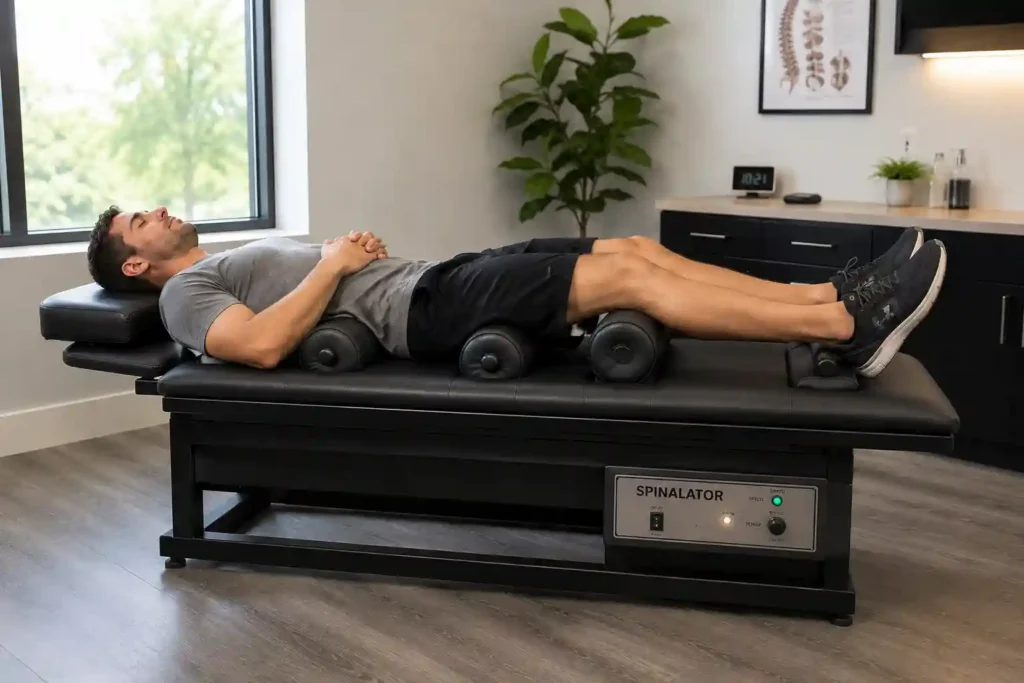
The Spinalator provides gentle mechanical movement along the spine using a series of rotating rollers beneath your back. The rhythmic motion is designed to help you relax before treatment while encouraging comfortable spinal movement and reducing muscular tension.
Not every patient needs intersegmental traction.
We evaluate your condition first.
If we believe the Spinalator may be beneficial as part of your care, we’ll explain why we’re recommending it and how it fits into your overall treatment plan.
Book a consultation and we’ll assess whether Spinalator Intersegmental Traction is right for you.
The Spinalator is a specialized chiropractic treatment table designed to provide intersegmental traction therapy.
Unlike spinal manipulation, the Spinalator doesn’t perform chiropractic adjustments. Instead, it uses a series of motorized rollers that move slowly beneath your spine while you remain comfortably lying on the table.
As the rollers travel up and down your back, they create a gentle lifting motion beneath each spinal segment.
Many patients describe the experience as relaxing, similar to a slow rolling massage combined with gentle stretching.
The treatment is completely passive.
You don’t need to perform any exercises or movements while using the table.
Instead, the Spinalator allows your body to relax while the rollers move rhythmically beneath your spine.
Depending on your individual treatment plan, we may recommend Spinalator therapy before or after other chiropractic procedures.
What Is Intersegmental Traction?
Intersegmental traction is a conservative therapy that introduces gentle, repetitive movement throughout the spine.
Rather than applying forceful pressure, the rollers create controlled motion between neighboring spinal segments.
The goal is to encourage comfortable movement while helping muscles surrounding the spine relax.
Healthy spinal movement depends on many different structures working together, including:
- Vertebrae
- Intervertebral discs
- Facet joints
- Ligaments
- Muscles
- Connective tissues
- Nerves
When muscles become tight or movement becomes restricted, even normal daily activities may begin feeling uncomfortable.
Intersegmental traction is designed to introduce gentle movement before chiropractic treatment.
For many patients, this creates a more relaxed treatment experience.
How Does the Spinalator Work?
The Spinalator uses three rotating rollers positioned beneath the treatment table.
As you lie comfortably on your back, the rollers slowly travel along your spine.
Each roller gently lifts different areas of your back in sequence.
This creates a repetitive motion that many patients find comfortable and relaxing.
The movement may help reduce muscle guarding before chiropractic adjustments.
Because every patient is different, the amount of pressure can often be adjusted according to your comfort level and treatment goals.
Our focus isn’t on using as much pressure as possible.
Instead, we want to create a treatment experience that’s comfortable, controlled, and appropriate for your condition.
Why Do We Use the Spinalator Before Chiropractic Adjustments?
Muscles naturally tighten when they’re painful, irritated, or under stress.
This protective response can sometimes make chiropractic adjustments feel less comfortable.
For selected patients, intersegmental traction may help reduce muscular tension before treatment.
Preparing the surrounding muscles may allow us to perform chiropractic care more comfortably.
The Spinalator is not intended to replace chiropractic adjustments.
Instead, it serves as one tool we may use to prepare your body before treatment.
Depending on your examination findings, your appointment may or may not include Spinalator therapy.
Every recommendation is based on your individual needs rather than a standard office routine.
Who May Benefit From Intersegmental Traction?
Intersegmental traction may be appropriate for patients experiencing certain musculoskeletal concerns involving the back or spine.
Following a comprehensive examination, we may consider the Spinalator as part of care for patients experiencing:
- Back stiffness
- Muscle tightness
- Reduced spinal mobility
- General spinal discomfort
- Neck and back muscle tension
- Postural strain
- Mechanical back pain
- Recovery from repetitive physical activity
- Muscular soreness associated with prolonged sitting
- General spinal fatigue
Having one of these symptoms doesn’t automatically mean you’ll receive Spinalator therapy.
We first determine what’s contributing to your discomfort.
Some patients benefit more from chiropractic adjustments alone.
Others may benefit from manual therapy, therapeutic exercise, or another conservative treatment approach.
Our recommendations are always based on your examination findings.
Conditions We Evaluate Before Recommending the Spinalator
Many people search online looking for treatment of conditions such as:
- Herniated discs
- Bulging discs
- Sciatica
- Degenerative disc disease
- Spinal stenosis
- Chronic lower back pain
These diagnoses can sound similar, but they don’t always produce the same symptoms.
Two people with the same MRI findings may have very different physical examinations.
That’s why we don’t recommend the Spinalator based solely on a diagnosis.
Instead, we evaluate:
- Your symptoms
- Medical history
- Physical examination
- Range of motion
- Muscle tension
- Joint mobility
- Neurological findings when appropriate
- Previous imaging if available
If we believe intersegmental traction may be appropriate, we’ll explain why.
If another treatment—or referral to another healthcare provider—is more appropriate, we’ll discuss that honestly.
How the Spinalator May Support Comfortable Movement Before Chiropractic Care?
The Spinalator Intersegmental Traction Table is often used as a preparatory therapy before chiropractic treatment. Rather than replacing an adjustment, it may help your body relax before hands-on care begins.
Many patients spend hours each day sitting at a desk, driving, or performing repetitive tasks that contribute to muscular tension and spinal stiffness. When muscles surrounding the spine become tight, movement may feel restricted and certain positions may become uncomfortable.
Intersegmental traction introduces gentle, repetitive movement that may help reduce muscular guarding before treatment. For some patients, this creates a more comfortable experience during chiropractic care.
Because every patient responds differently, we continually monitor how your body reacts to treatment and modify your care plan as needed.
Potential Benefits of Intersegmental Traction Therapy
The purpose of the Spinalator isn’t to “fix” your spine or permanently correct structural problems.
Instead, it may support your overall chiropractic treatment plan by helping your body prepare for movement-based care.
Depending on your condition, patients may experience benefits such as:
- Gentle relaxation of spinal muscles
- Reduced muscular tension
- Improved comfort before chiropractic adjustments
- Increased tolerance for spinal movement
- Temporary reduction in feelings of stiffness
- Improved readiness for manual treatment
- A relaxing treatment experience
- Greater ease during certain movements
Every patient’s response is unique.
Some patients describe feeling noticeably more relaxed after treatment, while others appreciate the gentle stretching sensation produced by the moving rollers.
Our focus is always on helping you move more comfortably rather than promising a specific outcome.
Conditions We Commonly Evaluate Before Considering the Spinalator
Intersegmental traction may be considered for patients experiencing a variety of musculoskeletal concerns.
Following a comprehensive examination, we may determine that the Spinalator is appropriate as part of care for patients experiencing:
Chronic Back Stiffness
Persistent stiffness may develop after prolonged sitting, repetitive work activities, previous injuries, or age-related changes.
Gentle movement through the Spinalator may help prepare your muscles before chiropractic treatment.
Muscle Tightness
Muscles surrounding the spine often become tight when protecting painful or irritated joints.
Intersegmental traction may help encourage relaxation before manual therapy or chiropractic adjustments.
Mechanical Back Pain
Mechanical back pain refers to pain influenced by movement, posture, or physical activity.
Because mechanical pain can have many causes, we perform a complete examination before determining whether Spinalator therapy may be appropriate.
Reduced Spinal Mobility
Some patients simply feel that their back doesn’t move as freely as it once did.
Movement restrictions may occur gradually over time or after injury.
If your examination suggests reduced mobility is contributing to your symptoms, we may incorporate intersegmental traction into your treatment plan.
Postural Muscle Fatigue
Long hours at a computer, prolonged driving, frequent lifting, and repetitive work tasks can place continuous demands on the muscles supporting your spine.
Many patients appreciate the relaxing nature of the Spinalator after physically demanding days.
Is the Spinalator Right for Everyone?
No.
Although the Spinalator is considered a gentle treatment option, it isn’t appropriate for every patient.
Before recommending intersegmental traction, we review your:
- Medical history
- Current symptoms
- Previous injuries
- Surgical history
- Imaging when available
- Current diagnosis
- Overall health
- Physical examination findings
Depending on your condition, we may determine that another conservative treatment is more appropriate.
Some patients may benefit more from chiropractic adjustments alone.
Others may benefit from manual therapy, rehabilitative exercises, or referral for additional medical evaluation.
Our recommendations are always based on your individual needs—not a standard protocol.
What to Expect During Your First Spinalator Session?
Your first visit always begins with a consultation and examination.
We take time to understand:
- When your symptoms began
- What activities increase or reduce discomfort
- Previous injuries
- Previous chiropractic treatment
- Medical history
- Current medications
- Daily work activities
- Exercise habits
- Your treatment goals
After completing your examination, we’ll explain our findings and discuss whether intersegmental traction may be appropriate.
If we recommend the Spinalator, you’ll lie comfortably on the treatment table while the rollers move gently beneath your spine.
The movement is slow, rhythmic, and designed to remain comfortable throughout the session.
Many patients describe the experience as relaxing.
If you experience discomfort at any point, we encourage you to let us know immediately so we can modify or discontinue treatment.
Communication is an important part of your care.
Can the Spinalator Be Combined With Other Chiropractic Treatments?
Yes.
For many patients, the Spinalator is just one component of a personalized treatment plan.
Depending on your examination findings, your care may also include:
- Chiropractic adjustments
- Manual therapy
- Instrument-Assisted Soft Tissue Mobilization (IASTM)
- Active Release Technique (ART)
- Therapeutic stretching
- Neuromuscular re-education
- Kinesiology taping
- Deep tissue laser therapy
- Corrective exercises
- Home mobility recommendations
Every recommendation has a purpose.
We explain how each treatment fits into your overall care plan so you understand why it has been selected.
Why Choose Cucci Chiropractic?
At Cucci Chiropractic, we believe every patient deserves individualized care.
We don’t use the same treatments for everyone who walks through our door.
Instead, we begin with a thorough evaluation to understand your symptoms, movement, and goals.
Our approach focuses on:
- Personalized chiropractic care
- Conservative treatment options
- Individualized treatment planning
- Gentle techniques when appropriate
- Clear communication
- One-on-one attention
- Ongoing reassessment
- Honest recommendations
If we believe the Spinalator may be beneficial, we’ll explain why.
If another treatment is more appropriate, we’ll discuss that with you as well.
Our priority is helping you make informed decisions about your care.
Schedule Your Consultation
If back stiffness, muscle tension, or reduced spinal mobility is affecting your daily activities, we’re here to help you better understand what may be contributing to your symptoms.
At Cucci Chiropractic, we’ll perform a comprehensive evaluation, discuss your concerns, and recommend a personalized treatment plan based on your individual needs.
If the Spinalator Intersegmental Traction Table may be an appropriate part of your care, we’ll explain how it works, what you can expect, and how it fits into your overall chiropractic treatment plan.